Aggregation and Magnetic Separation of Polyethylene Microparticles from Aqueous Solutions
aMikheev Institute of Metal Physics, Ural Branch, Russian Academy of Sciences, Yekaterinburg, 620108 Russia
bUral State Mining University, Yekaterinburg, 620144 Russia
email: *filinkova-ms@yandex.ru
Received 17 June, 2024
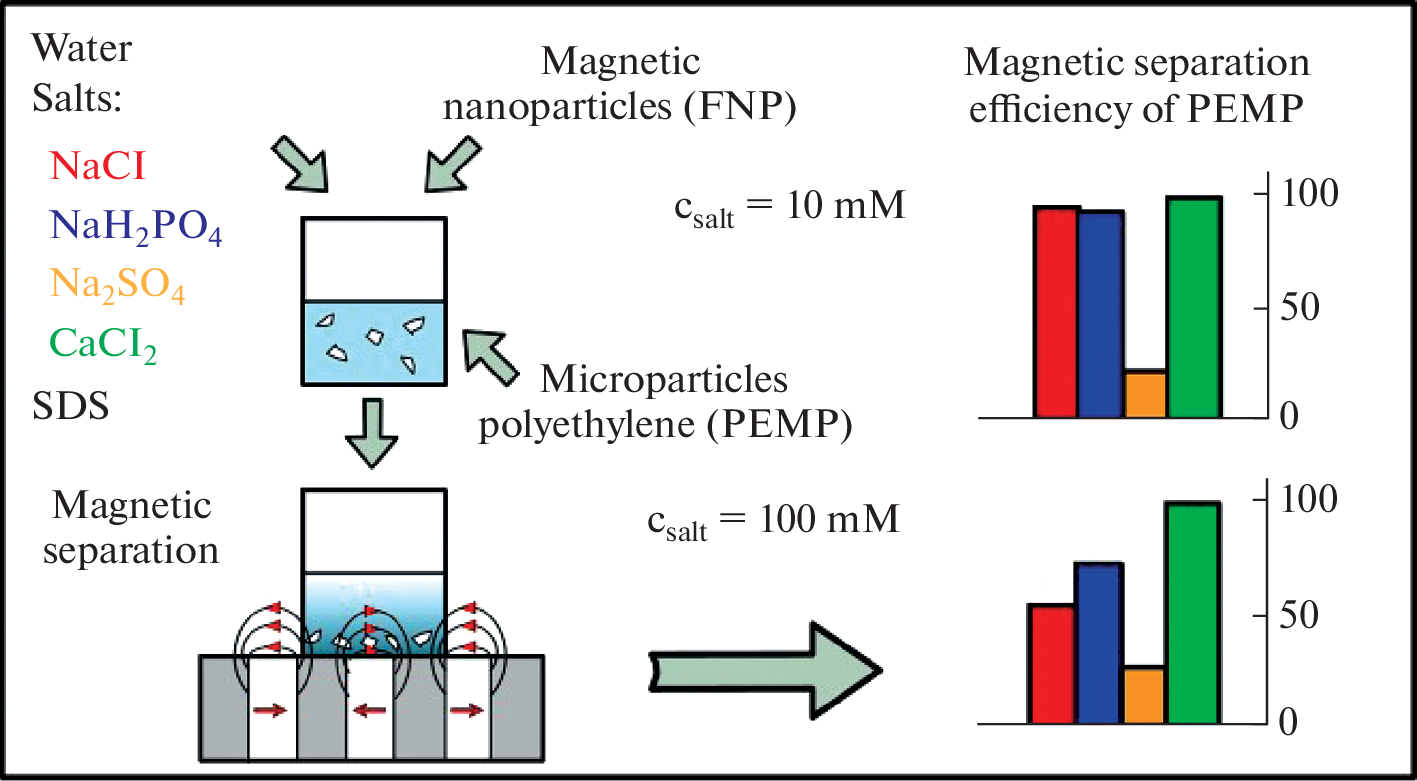
Abstract— The determination of the amount and composition of artificial polymer microparticles in ponds requires the preparation of representative water samples. A new method has been proposed in this work for magnetic separation of polyethylene microparticles (PEMPs, 10–200 μm), with the method implying their aggregation with magnetic nanoparticles. Composite magnetic nanoparticles containing magnetite cores and silica shells functionalized with amino groups (Fe3O4@SiO2–NH2, dhydr = 200 nm) have been synthesized and characterized. Due to electrostatic interactions, these nanoparticles can form aggregates with polyethylene particles and be separated from water under the action of a gradient magnetic field. The effects of added salts (NaCl, Na2SO4, NaH2PO4, and CaCl2) and a surfactant, sodium dodecyl sulfate (SDS), on the separation conditions of PEMPs from water have been studied. It has been shown that the addition of the magnetic particles in concentration c = 0.01 g/L to aqueous suspensions containing NaCl and NaH2PO4 (c = 10 mM), and SDS (c = 3 mM) provides an efficiency of magnetic separation of PEMPs equal to, at least, 98% after preliminary exposure for 30 min and magnetic sedimentation for 15 min. As the concentration of NaCl and NaH2PO4 is increased to 100 mM or in the presence of Na2SO4, the efficiency of PEMP magnetic separation decreases. In the presence of CaCl2 and SDS, the efficiency of the magnetic sedimentation is no less than 98% at the studied concentrations of the salts. At least 80% of PEMPs are separated by magnetic filtration from model solutions simulating river and sea water within 5 min.
Keywords: ferromagnetic nanoparticles (FNPs), polyethylene microparticles (PEMP), water suspensions, magnetic field gradient, heteroaggregation, magnetic separation
DOI: 10.1134/S1061933X24600581