Structuring of Graphene Oxide Interacting with Nanodiamonds in Aqueous Dispersions
aPetersburg Nuclear Physics Institute named by B.P. Konstantinov, National Research Center “Kurchatov Institute”, Gatchina, 188300 Russia
bIoffe Institute, St. Petersburg, 194021 Russia
cSt. Petersburg State University, St. Petersburg, 199034 Russia
dFrank Laboratory of Neutron Physics, Joint Institute for Nuclear Research, Dubna, 141980 Russia
email: *kulvelis_yv@pnpi.nrcki.ru
Received 7 June, 2024
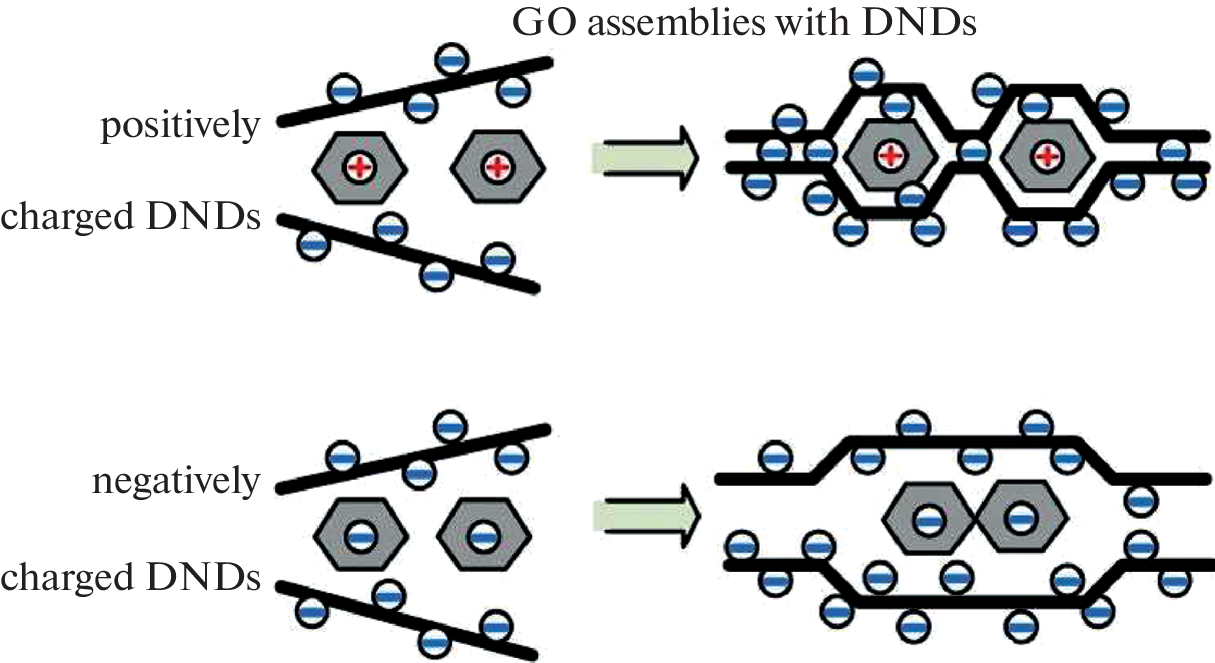
Abstract— Small-angle neutron scattering has been used to study the mechanisms of graphene oxide self-organization in aqueous dispersions during its interaction with detonation nanodiamonds having different surface potential signs. Being mixed with a hydrosol of positively charged diamonds, negatively charged graphene oxide yields a stable colloid due to the formation of planar heterostructures in the form of paired sheets tightly connected through diamonds (25 wt %) when the sheets are joined. Under similar conditions, diamonds with a negative potential are localized between graphene sheets to form, at an increased fraction (44 wt %), less dense assemblies with a gap between the sheets on the order of the diamond particle radius. The binding of graphene oxide to diamonds has been confirmed by transmission electron microscopy data.
Keywords: graphene oxide, nanodiamond, structure, neutron, scattering
DOI: 10.1134/S1061933X24600830