Highly Effective Photocatalytic Degradation of Malachite Green Dye for Waste Water Treatment through 1T/2H MoS2 Nanoflower
aResearch Lab for Energy Systems, Department of Physics, N.S.U.T, Dwarka, New Delhi, 110078 India
bMaterial Engineering Department, Ming Chi University of Technology, Taishan District, New Taipei City, 243 Taiwan
cRamjas College, University Enclave, University of Delhi, Delhi, 110007 India
email: *ajay211193@gmail.com
Received 25 November, 2023
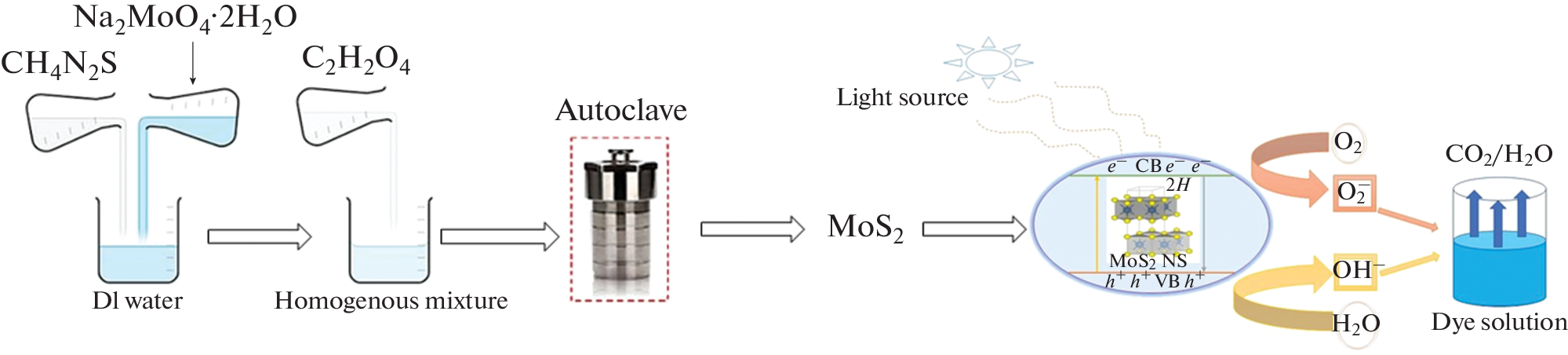
Abstract— The scientific community has preferred the photocatalysis process to remove organic pollutants from water. Many catalysts have been developed over the years, and one such catalyst is molybdenum disulfide (MoS2), which is a two-dimensional (2D) material with an energy bandgap in the visible spectrum. In this manuscript, the facile synthesis of MoS2 nanostructures in varying molybdenum (Mo) and sulphur (S), Mo/S ratios has been demonstrated through a single-pot hydrothermal route. The structural validation of the nanostructures was done using X-ray diffraction (XRD) patterns. Further, the morphological information about the MoS2 nanostructures was gathered using the Field Emission Scanning Electron Microscope (FE-SEM) and High-Resolution Transmission Electron Microscope (HR-TEM) analyses. The photodegradation process of the Malachite Green dye was analyzed by UV-visible absorption spectroscopy. The results showed that 1T/2H MoS2 nanoflowers degraded the malachite green dye with a degradation efficiency of 98.4%. The decomposition of this commonly used dye possesses great significance in industrial waste water treatment.
Keywords: transition metal dichalcogenides, organic dye degradation, organic waste water treatment, photocatalysis, MoS2 nanostructure
DOI: 10.1134/S1061933X2360118X