Interaction of Ultrasmall Gold Nanoparticles with Liquid-Crystalline DNA Microparticles: Destruction vs Stabilization
aEmanuel Institute of Biochemical Physics, Russian Academy of Sciences, Moscow, 119334 Russia
bBurnasyan Federal Medical Biophysical Center, Federal Medical Biological Agency, Moscow, 123098 Russia
cFrumkin Institute of Physical Chemistry and Electrochemistry, Russian Academy of Sciences, Moscow, 119071 Russia
email: *morozov.v.n@mail.ru
Received 2 November, 2023
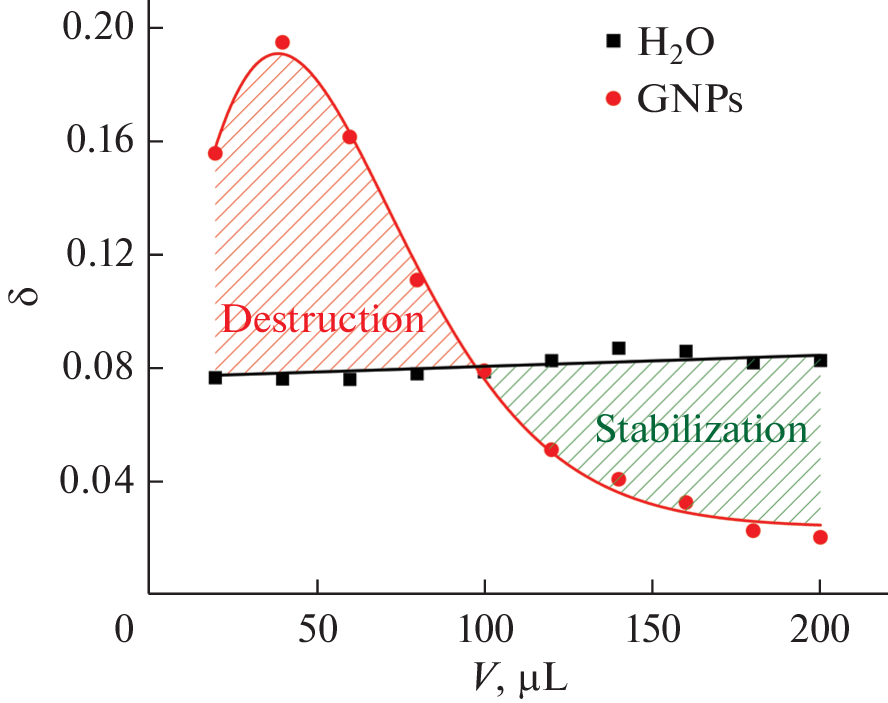
Abstract— The interconnection between the destructive and stabilizing effects of ultrasmall gold nanoparticles (GNPs) synthesized by the Duff method in relation to the internal structure of the particles of DNA liquid-crystalline dispersions (LCDs), depending on the degree of their ordering, was studied. It is shown that “stabilization” of the particles’ ordered structure is, in fact, a consequence of its “destruction.” The dominance of one or another effect depends in a complex way on the distance between neighboring DNA molecules within the particles of its LCD, determined by osmotic conditions, and the efficiency of penetration of GNPs into these particles.
Keywords: liquid crystals, DNA, circular dichroism, gold nanoparticles
DOI: 10.1134/S1061933X24600234