The Self-Organization and Gelation Processes in a Cysteine–Silver Solution Containing Chitosan and an Electrolyte
aTver State University, Tver, 170100 Russia
email: *zenikov.german@mail.ru
Received 1 November, 2023
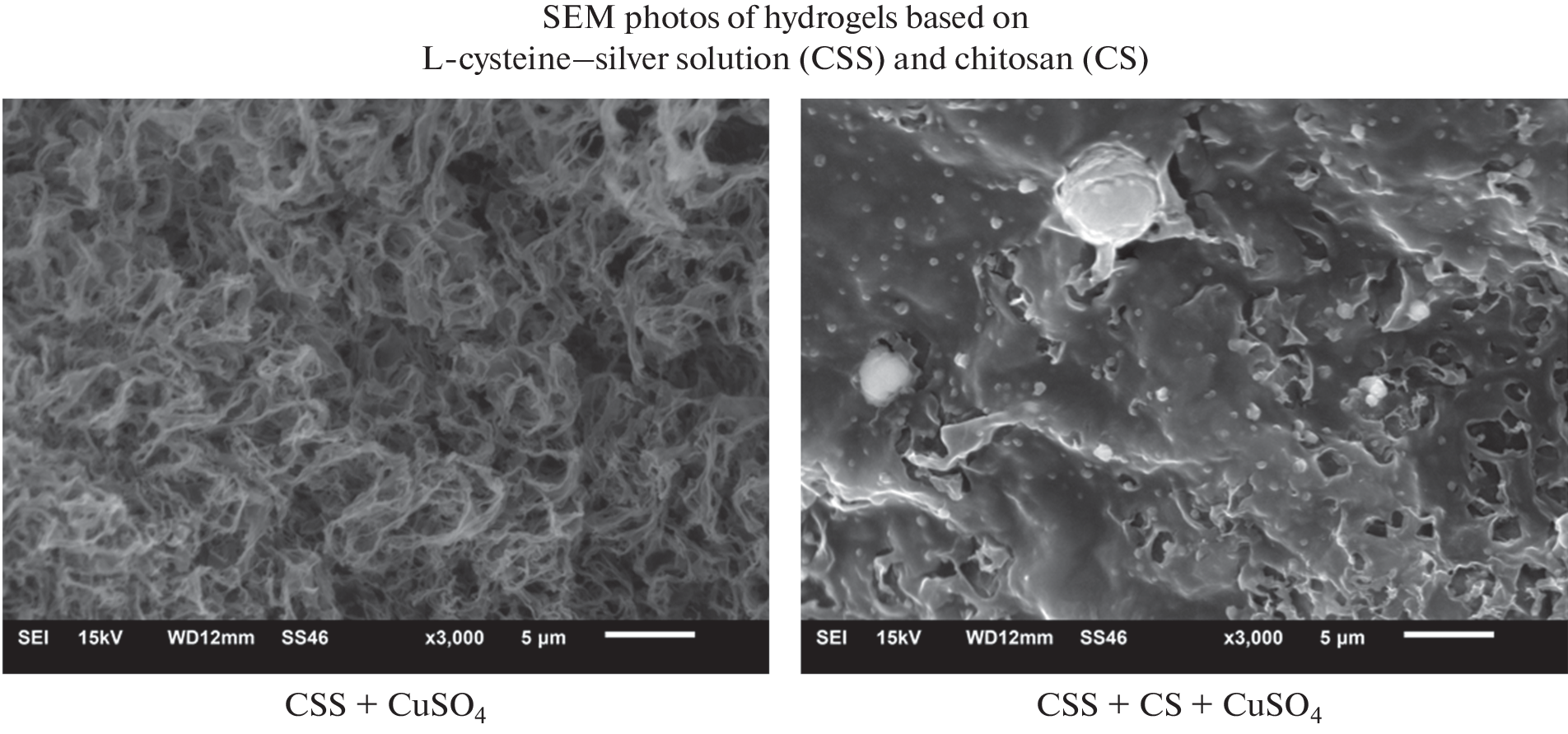
Abstract— The self-assembly and gelation processes in low-concentrated aqueous solutions of L-cysteine and silver nitrate (cysteine–silver solution, CSS); low-molecular-weight water-soluble chitosan (CS); and a gelation initiator, CuSO4, have been studied by various physicochemical methods, namely, UV spectroscopy, dynamic light scattering, pH-metry, viscometry, and scanning electron microscopy. It has been found that the gelation of CSS, which is used as a gel precursor, under the action of chitosan (CS) and copper sulfate occurs in a narrow concentration range: CCH = 0.0100–0.0150 mg/mL, \({{C}_{{{\text{CuS}}{{{\text{O}}}_{{\text{4}}}}}}}\) = 0.4–0.6 mМ, CL-cys = 3.00 mМ, and \({{C}_{{{\text{AgN}}{{{\text{O}}}_{{\text{3}}}}}}}\) = 3.75 mM, when Ag+/Cys molar ratio is 1.27. Hydrogels of various CSS–CS and CSS–CS–CuSO4 compositions possess no high mechanical strength; however, they are stable in the course time. The structural elements of CSS, i.e., cluster chains of silver merchaptide (SM) zwitterions, are positively charged; therefore, no polyelectrolyte complexation occurs in CSS–CS and CSS–CS–CuSO4 hydrogels, because the pH of CSS is 2.6. Addition of CuSO4 to CSS–CS samples promotes the formation of a more strong hydrogel due to the association of SM clusters and CS molecules with sulfate anions and the coordination of Cu(II) ions with deprotonated carboxyl groups of different clusters.
Keywords: cysteine–silver solution (CSS), water-soluble chitosan, antimicrobial activity, supramolecular chemistry, hydrogels
DOI: 10.1134/S1061933X24600143